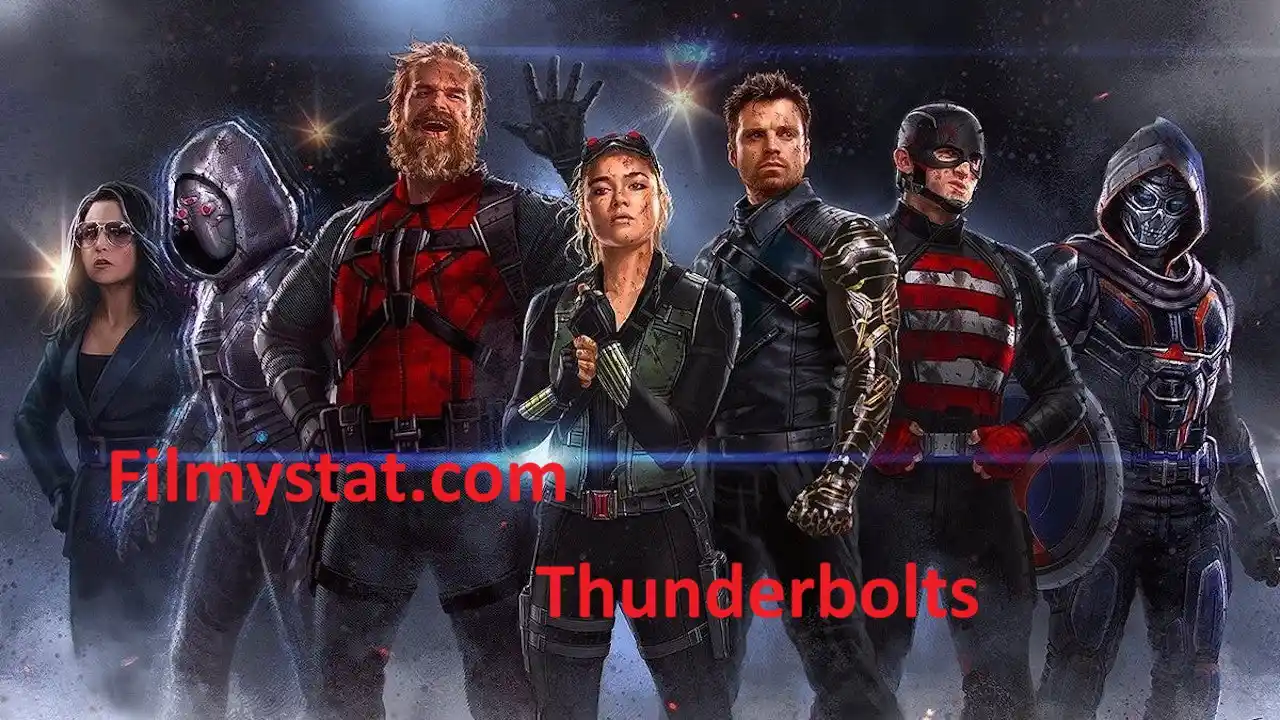
Thunderbolts is one of Marvel Studios’ most unconventional projects, designed to explore the darker, morally complicated side of the Marvel Cinematic Universe. Unlike traditional superhero teams driven by idealism, Thunderbolts brings together anti-heroes, former villains, and broken soldiers who operate in moral gray zones.
Positioned as a grounded, character-driven ensemble film, Thunderbolts focuses less on saving the world and more on survival, accountability, and consequences. This movie represents Marvel’s attempt to reshape team dynamics by embracing flawed characters rather than perfect heroes.
This full guide covers the story concept, cast, team members, themes, action style, and why Thunderbolts matters to the MCU.
Thunderbolts
| Detail | Information |
|---|---|
| Movie Title | Thunderbolts |
| Release Year | 2025 |
| Genre | Superhero, Action, Thriller |
| Studio | Marvel Studios |
| Language | English |
| MCU Phase | Phase Five |
| Team Type | Anti-hero ensemble |
| Tone | Dark, grounded, intense |
What Is Thunderbolts About?
At its core, Thunderbolts is Marvel’s version of a government-controlled strike team. Instead of costumed heroes motivated by hope, this team is assembled out of necessity. These are individuals with violent pasts, emotional damage, and questionable loyalties.
The team is brought together to handle missions that traditional heroes cannot or will not take. Their assignments are dangerous, politically sensitive, and morally complex.
This approach allows Marvel to tell a more realistic and grounded story within its superhero framework.
Story Overview
The story follows a covert government initiative that recruits enhanced individuals and skilled operatives with troubled histories. Under strict supervision, they are sent on high-risk missions where failure is not an option.
Each member joins the team for different reasons:
- Redemption
- Reduced prison sentences
- Forced compliance
- Survival
As the mission unfolds, trust within the group becomes fragile. Conflicting personalities and hidden agendas threaten the team from within, making internal conflict just as dangerous as the external threat.
Thunderbolts Team Members
Yelena Belova
Yelena serves as the emotional center of the team. Trained, lethal, and sarcastic, she struggles with loss and identity after the events of Black Widow. Her leadership potential emerges naturally rather than through authority.
Bucky Barnes (Winter Soldier)
Bucky represents the cost of forced obedience. His presence brings experience, restraint, and emotional weight. He understands what it means to be used as a weapon, making him a moral anchor for the group.
Red Guardian
Loud, insecure, and desperate for relevance, Red Guardian adds tension and unpredictability. Beneath the humor lies a deeply flawed man seeking validation.
U.S. Agent (John Walker)
Aggressive and unstable, Walker embodies the dangers of authority without emotional control. His sense of justice often clashes with the rest of the team.
Ghost
A silent and haunted figure, Ghost brings stealth and emotional distance. Her condition makes her both an asset and a liability.
Taskmaster
Highly skilled and emotionally detached, Taskmaster functions as a weapon rather than a person. Trusting her becomes a challenge.
Leadership and Control
Unlike the Avengers, the Thunderbolts do not operate independently. The team is monitored, controlled, and deployed by government forces. Their freedom is limited, and consequences are immediate.
This structure creates constant tension between obedience and rebellion, raising questions about autonomy and exploitation.
Themes Explored in Thunderbolts
Redemption
Can people with violent pasts truly change, or are they defined forever by their mistakes?
Control and Power
The film questions whether governments should control enhanced individuals and how easily power becomes abuse.
Trauma
Every member carries psychological scars. The story treats trauma as something lived with, not quickly cured.
Moral Gray Zones
Right and wrong are rarely clear. Characters make choices based on survival rather than heroism.
Action Style and Tone
The action in Thunderbolts is expected to be:
- Brutal and grounded
- Focused on tactical combat
- Less flashy than Avengers-level battles
- Driven by character decisions
Fight scenes emphasize physical impact and risk rather than spectacle.
Visual Style and Cinematography
The film adopts a muted color palette with realistic lighting. Urban environments, military locations, and confined spaces dominate the visuals, reinforcing the grounded tone.
Cinematography prioritizes intimacy and tension over scale.
How Thunderbolts Fits into the MCU
Thunderbolts plays a critical role in expanding the MCU’s political and ethical landscape. It explores what happens when heroes are no longer symbols, but tools.
The movie also bridges street-level stories with larger MCU consequences, setting up future conflicts involving authority, surveillance, and control.
Why Thunderbolts Is Important
- Introduces a morally complex team dynamic
- Expands the MCU beyond traditional heroism
- Explores consequences of power and trauma
- Offers a darker alternative to Avengers-style films
It represents Marvel’s attempt to evolve its storytelling.
Frequently Asked Questions
Is Thunderbolts a villain team?
No. They are anti-heroes operating under government control.
Is this movie connected to Black Widow and Falcon and the Winter Soldier?
Yes. It directly continues character arcs from those projects.
Is Thunderbolts darker than other MCU films?
Yes. The tone is more grounded and intense.
Will Thunderbolts replace the Avengers?
No. It exists alongside other MCU teams.
Final Verdict
Thunderbolts is a bold shift for Marvel Studios. By focusing on flawed characters, moral ambiguity, and grounded action, the film offers a fresh perspective within the MCU.
This is not a story about heroes rising.
It is a story about damaged people being used to solve impossible problems.
For viewers seeking mature, character-driven superhero cinema, Thunderbolts could become one of Marvel’s most compelling ensemble films.
Related: Phase Five >> Chronological Order >> Hub Page